

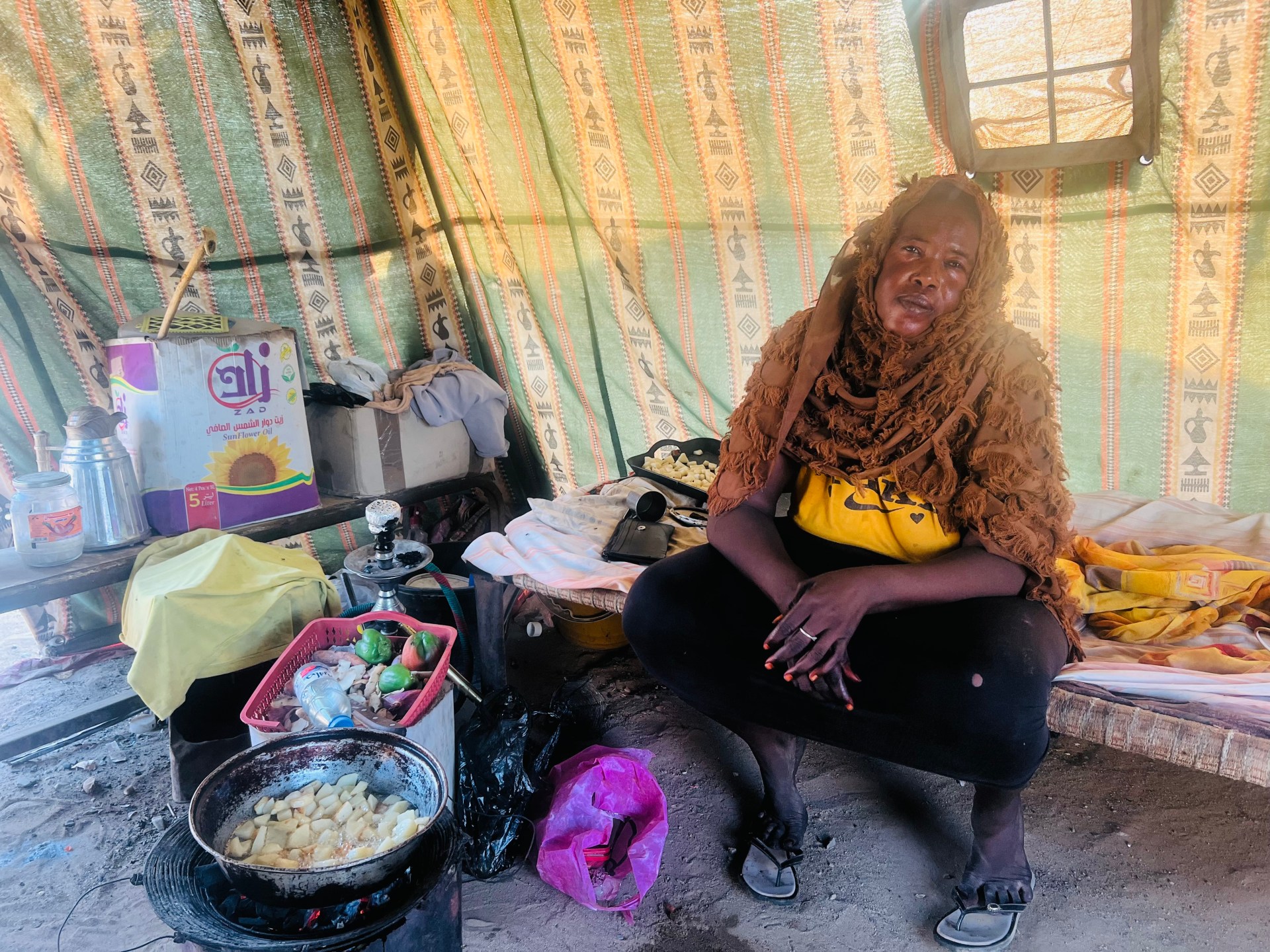
Warning: This story contains descriptions of sexual assault that some readers may find disturbing.
Port Sudan, Sudan – In Sudan’s displacement camps, the stories of residents often follow similar paths, but each loss and hardship is a deeply personal experience.
Recommended Stories
list of 4 itemsend of list
Arafa Abdelaziz endured a dangerous 15-day journey from Omdurman to a displacement camp in Port Sudan in late 2023, after losing her husband and one of her two sons, who died early in the war.
Her husband died just days after fighting broke out between the Sudanese Armed Forces (SAF) and the paramilitary Rapid Support Forces (RSF) in April 2023, leaving her to care for her remaining two children as their home city of Omdurman in Khartoum State came under bombardment.
Five months later, her eight-year-old son was killed by a stray bullet during clashes near Omdurman’s market.
“My son was playing outside the house with his friends when I suddenly heard a loud noise. When I went outside, I found that his head had been shattered by gunfire,” said the 33-year-old.
With the fighting between the SAF and RSF continuing in Omdurman, one of the centres of the power struggle between the two former allies at the start of the war, Arafa eventually decided to flee the city with her six-year-old son, who has a brain condition affecting his development.
She describes the journey to Port Sudan as a prolonged and horrifying ordeal. Near Jebel Aulia, south of Khartoum, RSF fighters intercepted the vehicle they were in and the passengers were robbed and assaulted.
“They asked every woman carrying a child how she wanted her son to be killed. I told them to kill me before they touched my son,” Arafa recalled.
When she confronted the fighters as they attempted to assault her child, one of them hit her with the butt of his rifle, leaving her unconscious for more than an hour.
“When I regained consciousness, I saw RSF fighters raping the young women who were travelling with us on the bus. Some were raped in front of their fathers. I felt it was the end,” she said.
In October 2026, UN Women reported that 12.7 million people, mostly women and girls, needed support for gender-based violence in Sudan – four times the pre-war figure.
The agency warned that sexual violence is being used as a weapon of war, with women and girls at risk while fleeing areas of fighting, in displacement camps and while searching for food, water and shelter.
Arafa said her greatest fear throughout the ordeal was for her younger son’s safety. When the fighters asked what valuables she had, she told them she owned nothing. They took two gold rings from her fingers and after severely beating her, let her continue her journey.
“I arrived in Port Sudan with nothing, having lost my husband. My son’s condition had worsened because of what we went through on the journey and because he could not receive his medication regularly,” she said.
It was Arafa’s first time in Port Sudan, so, having no family or friends there to support her, she headed to a school sheltering displaced families. She was later transferred to another displacement camp, where she now lives with her son. But reaching relative safety was not the end of her struggles. Her son’s condition fluctuates, and she remains worried about his health and future.
“Sometimes he imagines strange things because of his illness,” she said. “Yesterday, he told me he could see a lot of blood on the ground. It makes me think every day about his future with this condition.”
Arafa cannot afford his medication, so she has resorted to giving him medicine only when his condition deteriorates. She depends largely on aid distributed in the camp, as her needs and those of her son continue to grow.
“I’m afraid to leave him alone at home, out of my sight, in case he has a seizure or hurts himself,” she said.
The war in Sudan has killed as many as 150,000 people and forced millions from their homes, often to camps in impoverished neighbouring countries.
Income levels have dropped to 1992 levels and extreme poverty rates are worse than in the 1980s, according to the United Nations. Due to conscription, fatalities and emigration to other regions and countries for work, women have become the sole guardians in many displaced Sudanese households.
The UN’s 2025 Gender Snapshot found that 75 percent of female-headed households in Sudan were food insecure – three times the rate among male-headed households.

The Mashad Observatory has documented 72,202 cases of widowhood since the outbreak of war in Sudan in April 2023. That constitutes a complex humanitarian crisis which can lead to the collapse of household incomes, stability and protection systems. In the long term, it means transmitting deprivation, economic vulnerability and psychological trauma from one generation to the next.
These cumulative impacts can weaken social cohesion, exacerbate inequalities and undermine the capacity of local communities to recover from the consequences of war. This growing burden means fewer opportunities for women to work and increased dependence on humanitarian assistance, with long-term economic implications for Sudan, the group said.
“Their suffering is further compounded when women lose the primary source of household income or are forced to abandon their homes and communities without adequate financial resources or social support networks. Such circumstances may expose them to heightened risks of economic exploitation, gender-based violence, forced or early marriage involving their daughters and the interruption of their children’s education,” a spokesperson for the organisation told Al Jazeera.
“These pressures may also contribute to deteriorating mental health as a result of cumulative trauma, overwhelming responsibilities and the absence of appropriate psychosocial support services.”
With humanitarian agencies saying that Sudan’s 2026 response plan, which aims to reach 20.4 million people and requires $2.9bn, has received only 47% of the funding needed, there will be challenges in providing these families with the necessary support.
“Addressing this challenge therefore requires a transition from temporary emergency relief towards a comprehensive national strategy that places widows and female-headed households at the centre of Sudan’s recovery and reconstruction plans,” said the organisation.
“Such a strategy should include sustainable cash assistance, economic empowerment programmes, vocational training, access to decent employment, improved access to finance and productive enterprises, as well as guaranteed access to education, healthcare, legal protection and psychosocial support.”
Zahra Idris, 39, fled Khartoum with her husband and two children as shelling intensified, arriving in Port Sudan three years ago.
Her husband initially rented a house in the working-class neighbourhood of Al-Kasara. But when they could no longer afford the rent, the landlord evicted them. The family moved to a school shelter before being relocated to a displacement camp at the start of the school year.
Two months ago, Zahra’s husband died of heart disease, leaving her to care for their two children with little support beyond humanitarian assistance, which has become increasingly limited.
“Since my husband died, my fears have grown. I cannot go out to look for work until I complete the mourning period prescribed in Islam, which lasts four months and ten days,” she said.
Her 12-year-old son has an intellectual disability and requires regular medical care, something the family cannot afford given the rising cost of living.
“There is no one to help me. I just want my son’s condition to improve enough for him to attend a school for children with disabilities,” she said.
“Going from one organisation to another, looking for someone to cover my son’s medical treatment and education, cost me around 100,000 Sudanese pounds. That money could have covered our household needs for several days.”
Fuente original: Ver noticia original
